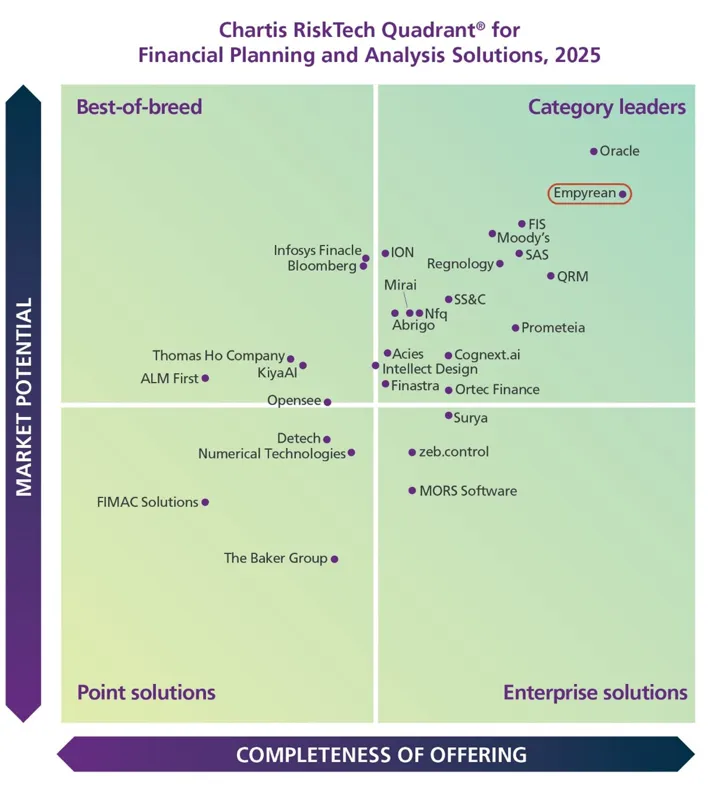

Consolidate your efforts into a single, integrated solution

Align assumptions and produce consistent results across all disciplines of risk and balance sheet management. Seamlessly and effortlessly deliver analysis to your executive team on how any change in conditions will impact earnings, enterprise value, liquidity, capital and earnings per share.

Never again feel as though you don’t have the time to effectively assess risk and recommend strategy.

Empyrean ALM®

Designed to be the foundation on which a sound balance sheet management discipline is built, Empyrean ALM® is the most efficient and intuitive cash flow, forecasting and simulation engine on the market. Developed in the aftermath of the 2008 financial crisis, Empyrean ALM is purpose-built to tackled the challenges of asset liability management and overall risk management for your bank or credit union. We know that how well a system delivers key results – the right mix of speed, flexibility, transparency, and ease of use – means as much, if not more, than check-the-box functionality:

Speed. Speed. Speed.

Built on our founders’ three-decade-long dedication to improve every component of a simulation, Empyrean ALM’s calculations are the fastest on the market. Model and simulate even more scenarios to inform your decision making process. Be productive, not busy.

Inherently Intuitive

Empyrean ALM is designed to follow the flow of how practitioners think and work. For risk practitioners, Empyrean’s asset liability management tool feels like second nature – our users find they are quick to achieve productivity with minimal training. Empyrean complements our easy-to-learn platform with regular community roundtables and free training sessions for users who want to dive deeper.

Transparent model with intuitive reporting

Empyrean leverages familiar tools like Excel for loading data and assumptions and outputting results. All information, including instrument data, assumptions, and results, is readily visible within the system interface – or through user-controlled Excel reporting. It’s transparent, easy, and powerful.

Converting is quick and risk free

We recognize that the demands of your job don’t stop when you decide to implement a new solution. Getting converted and into production as quick and as painless as possible isn’t a luxury, it’s a requirement. Because of Empyrean’s intuitive design and experienced support team, our customers go into production in a fraction of the time it takes with others.

See Empyrean ALM action – take our interactive demo and experience the power of Empyrean for yourself.”

See Empyrean ALM in action

Liquidity Stress Testing

Having a sound approach to managing liquidity risk has long been a pillar of prudent balance sheet management. It’s imperative to maintain a dynamic framework forecasting your liquidity position, its potential risks and failure points, and their impact on the performance, safety and soundness of the institution. This discipline is quickly evolving from being industry “best-practice” to regulatory requirement. How can you keep pace?

An extension of your ALM modeling

A dynamic extension of Empyrean ALM® allowing you to layer stresses of the various sources and uses of funds, borrowing capacities, and haircuts onto any ALM scenario’s balance sheet projection and market conditions to analyze its impacts.

Assess and optimize your strategy and plan

Enabling you to continuously assess the impact of stress on your funding strategy and contingency funding plan, simulate failure points and key risk metrics and ratios, and test, revise and mitigate your liquidity planning processes.

Appease regulatory demands

Designed to meet and exceed the guidelines laid out by the Interagency Policy Statement on Funding and Liquidity Risk Management SR10-6 and to eliminate the risk inherent with maintaining complex, outdated spreadsheets.

Smarter Modeling Starts With Model IQ™

Outdated, one-time assumptions and manual deposit studies can’t keep up with volatile rates and shifting behavior. Behavioral modeling software delivers faster, consistent assumptions that support daily financial decisions, reducing surprises.

Get a Demo

Empyrean Model IQ: Behavioral Modeling Made for Banks and Credit Unions

Empyrean Model IQ is a modular behavioral modeling software platform designed for banks and credit unions that need greater transparency, consistency, and control over their critical modeling assumptions.

Model validation software replaces static, one-time studies and opaque third-party models with ongoing, FI-specific calibration, testing, and governance. With integrated model validation software capabilities, Model IQ supports documented, auditable assumptions that flow into CECL, ALM, liquidity, and financial planning.

This enables faster updates, stronger defensibility, and more confident decision-making that cascades throughout an organization.

Why Choose Empyrean Model IQ

Deposit IQ

Model deposit decay, beta sensitivity, and early withdrawal behavior — including cannibalization analysis to separate new growth from internal balance transfers.

Loan IQ

Calibrate and backtest loan prepayments by product or segment. Use guided workflows for scenario planning, stress testing, and documentation.

Credit IQ

Build PD/LGD or net charge-off models using peer or internal data. Includes historical, regression, and cohort-based methodologies.

Model Library

Store validated models with assumptions, overlays, and audit documentation in one secure repository.

Comprehensive Analytics

Generate examiner-ready outputs with transparent calculations. Share insights across risk, planning, and leadership.

Guided Workflows

Simplify modeling with built-in workflows for validation, segmentation, and calibration — no in-house quants required.

Designed for Finance Leaders

Whether you are managing CECL, modeling liquidity, or supporting ALCO and exam readiness, Model IQ gives finance teams clear, defensible assumptions they can trust across every decision.

For Risk and Treasury

Calibrate behavioral assumptions across your balance sheet with models built for stress testing, ALM alignment, and CECL assumptions.

For Finance and Planning

Integrate models into rolling forecasts and budgeting tools with no reconciliation needed.

For Executives and Boards

View clear documentation and model outputs that support defensible decision-making.

One Platform to Manage Behavior, Governance, and Risk

Empyrean Model IQ works across deposit, loan, and credit modeling, connecting behavioral assumptions directly to CECL, ALM, and strategic planning.

Calibrate Behavior in Real Time

Replace static PDFs with dynamic, scenario-ready models.

Align Risk and Planning

Connect assumptions to forecasts, capital planning, and CECL reserves.

Prove Governance with Confidence

Show full audit trails and documentation in every model.

Frequently Asked Questions

What is behavioral modeling software for banks?

Behavioral modeling software helps banks quantify how customers actually behave when conditions change. This includes deposit sensitivity, loan prepayments, and credit performance.

Model IQ applies these behavioral insights directly to CECL, ALM, and liquidity planning. This ensures assumptions reflect real-world behavior rather than static averages.

Can finance teams use this without an analyst background?

Yes. Finance and risk professionals will find that support assumption setup, calibration, and review do not require advanced modeling expertise. Built-in documentation and transparent logic make it easy for teams to understand results, explain changes, and collaborate across departments.

How does Model IQ help with model validation?

Model IQ includes built-in model validation support, including version control, change tracking, and full audit trails. Teams can compare their assumptions over time, document rationale, and retain historical versions without manual files or spreadsheets.

What makes Model IQ different from other AI modeling tools?

Model IQ is purpose-built for banking use cases, not generic AI modeling. It supports flexible scenario analysis and integrates directly with CECL, ALM, liquidity, and planning workflows. Assumptions flow through the platform without exports, rekeying, or reconciliation, eliminating handoffs that would otherwise slow teams.

Interested in learning more?

Get a Demo

Read More About Behavioral Modeling and Model Governance

Funds Transfer Pricing

Net Interest Income is the main performance metric for most financial institutions. Is the bank earning enough income to justify the capital allocated by shareholders? How much will NII be impacted by changes to interest rates and liquidity premiums? These are questions an institution must be able to answer in order to effectively manage NII across the various lines of business and through different rate cycles. This is done most effectively through introducing a funds transfer pricing process that is both robust and effective in immunizing the business units from interest rate and liquidity risks while transferring them to the mis-match center, where ALCO can effectively manage it.

Consistency across all disciplines

As an extension of the ALM model, Empyrean’s FTP calculations will leverage the same data, behavioral settings, interest rates, other assumptions and calculation engines as all the other balance sheet management functions.

Comprehensive list of methodologies

Empyrean supports virtually every methodology for calculating the base funding rate for every instrument on the balance sheet as well as any addon charges or credits required by the institution (ie. liquidity premium, OAS, etc…).

Foundation for sound performance measurement

Let Empyrean form the foundation for your performance measurement efforts as the solution simulates and can export FTP rates at the instrument level for all current position instruments and for all forecast periods in every scenario.

Capital Planning & Stress Testing (DFAST)

When done properly, capital planning and stress testing can be an indispensable management tool informing senior management as they set balance sheet strategy. To move beyond a pain-inducing compliance and model risk management exercise and become part of balance sheet management best-practices, operating efficiency must be achieved. Empyrean was designed for this purpose.

Native credit modeling

Empyrean was created in response to the wave of regulation resulting from the most recent financial crisis, as such, capital planning and stress testing is a native part of Empyrean’s DNA.

Operational efficiency

Increase operational efficiency through tailor-made functionality: simulate and report at the legal entity level, build parallel account hierarchies (ie. product vs call code), model for credit losses and recoveries using a multitude of methodologies and approaches, forecast scenarios of macroeconomic variables, incorporate capital actions and calculate capital ratios.

Straightforward and defensible modeling

Straightforward, defensible, empirically-based modeling capabilities to predict credit losses and volume levels under any user-defined forecast or macro-economic conditions.

Transform Compliance into Balance Sheet Intelligence with Empyrean CECL

CECL success isn’t about perfect models. It’s about confidence, control, and consistency. Empyrean CECL helps community banks and credit unions turn CECL from a recurring operational scramble into a stable, defensible process that supports better decision-making.

Precision, Transparency, Control at Scale

CECL shouldn’t feel like a quarterly fire drill. Manual spreadsheets, opaque vendor models, and one-off assumptions make it hard for community banks and credit unions to produce consistent, defensible results.

Empyrean CECL is a purpose-built CECL software that helps financial institutions calculate lifetime expected credit losses with confidence. It replaces error-prone Excel models and black-box solutions with a transparent, workflow-driven platform designed for repeatability, audit readiness, and long-term sustainability.

Get a Demo

CECL Software Made for Banks and Credit Unions

Empyrean CECL is a structured, governance-first CECL application designed for community and mid-sized banks and credit unions. It enables finance and credit teams to produce accurate CECL estimates while clearly documenting assumptions, methodologies, and changes over time.

Unlike point solutions that operate in isolation, Empyrean CECL utilizes the same underlying data platform as Empyrean’s broader risk and performance platform. This allows CECL assumptions and results to be used in ALM, liquidity, and planning, eliminating reconciliation and strengthening consistency across the organization.

Why Choose Empyrean CECL

Replace Excel Without Adding Complexity

Move off error-prone spreadsheets and manual processes with a system designed for CECL from day one. Automated workflows reduce key-person risk and stabilize your quarterly close.

Transparency You Can Defend

Every assumption, adjustment, and result is traceable. Empyrean CECL provides a clear audit trail that makes it easy to explain reserve changes to auditors, examiners, and boards.

Built for Community Bank Reality

Designed for institutions with limited modeling resources, Empyrean CECL supports practical methodologies and a “start simple, grow over time” approach, no overengineering required.

Core CECL Capabilities

Flexible CECL Methodologies

Guided CECL Workflows

Built-In Documentation and Audit Trails

Scenario and Sensitivity Analysis

Designed for Finance, Credit, and Leadership

For CFOs and Finance Leaders

Run CECL with confidence and less personnel risk. Empyrean CECL reduces manual effort, shortens close cycles, and delivers results you can confidently stand behind.

For Credit and Risk Teams

Gain visibility into which portfolios and risk factors are driving reserves. Use consistent assumptions and methodologies that align with credit risk management practices.

For Executives and Boards

Clear, explainable outputs and documentation support stronger governance, oversight, and strategic discussions around capital and credit risk.

One Platform for CECL, Risk, and Planning

Empyrean CECL operates within Empyrean’s broader risk management platform, leveraging a common data foundation, shared assumptions, and consistent models used across ALM, liquidity, budgeting, and profitability. This approach establishes a unified source of truth for risk and finance without relying on disconnected processes or duplicate calculations.

By using common data and assumptions across disciplines, Empyrean CECL ensures credit loss estimates remain aligned with how institutions measure risk and performance across the balance sheet

Start Simple. Grow With Confidence.

Empyrean CECL supports a phased approach to CECL maturity:

  • Launch with foundational CECL compliance
  • Use simpler assumptions where appropriate
  • Add scenario analysis and sophistication over time
  • Avoid rip-and-replace as your institution grows

This approach reduces adoption risk and aligns with auditor and regulatory expectations for community institutions.

Empyrean CECL: Frequently Asked Questions

Answers to the questions community bank and credit union CFOs most often ask about CECL compliance and the Empyrean CECL platform.

Request a Demo to See Empyrean CECL in Action

Get a Demo

What is Empyrean CECL?

Empyrean CECL is a CECL compliance platform for community banks and credit unions that replaces manual, spreadsheet-based loss estimation with a governed, auditable quarterly process.

It runs on Empyrean Dataverse, the same data platform behind Empyrean's ALM, liquidity, and planning modules, so CECL assumptions stay consistent with the rest of the institution's balance sheet management.

Empyrean CECL supports Weighted Average Remaining Maturity (WARM), Probability of Default and Loss Given Default (PD/LGD), Static Pool and Cohort analysis, and Discounted Cash Flow (DCF) methodologies, and is built for institutions in the $500 million to $10 billion asset range.

What is CECL, and why does it matter for community banks?

CECL stands for Current Expected Credit Loss. It is the accounting standard under ASC 326 that replaced the older incurred loss model for estimating loan losses: instead of waiting until a loss is probable, every institution must estimate lifetime expected credit losses on its entire loan portfolio from the moment a loan is originated.

For large banks, CECL is a modeling exercise handled by dedicated risk teams. For community banks and credit unions, it is usually run by the CFO personally, using a spreadsheet or a point solution purchased to get into compliance quickly. That makes the quarterly process operationally fragile, hard to document consistently, and stressful to defend during audits or exams.

CECL matters for community banks not just because it is a regulatory requirement, but because it creates ongoing operational and governance demands that most small finance teams were not built to handle. Institutions that treat CECL as a repeatable, documented process supported by the right tools get cleaner audit opinions and more confident responses to examiner questions.

Why is CECL still an operational burden for community banks in 2026?

CECL compliance deadlines passed years ago, but the operational burden has not gone away. Economic volatility has increased scrutiny on reserve adequacy and methodology justification, which keeps the workload high even for institutions that have been compliant for years.

The core challenge is that CECL requires community banks to do three things at once: estimate lifetime credit losses using forward-looking economic assumptions, document those assumptions so auditors and examiners can independently verify them, and repeat that process accurately every quarter without errors.

Common problems that persist in 2026 include:

  • Limited historical loss data: many community banks have too few loan defaults in their history to build statistically robust models.
  • Lack of internal credit modeling expertise.
  • A manual, quarterly process run in Excel or a basic vendor tool.
  • Difficulty validating and documenting Qualitative and Environmental (Q and E) factor adjustments.
  • Ongoing uncertainty about what an examiner will challenge next quarter.

Many institutions completed their initial CECL transition during or after COVID, when actual loan losses were abnormally low. Depending on methodology quality, some under-reserved during that transition and have seen volatile CECL estimates ever since, which generates recurring questions from auditors, regulators, and boards.

Who typically owns CECL at a community bank?

At most community institutions, the CFO owns the CECL process entirely; it is not a delegated function the way it often is at larger banks.

The economic buyer for a CECL solution is almost always the CFO, with the CEO as an approver on larger deals. Key influencers include the Controller, the Credit Risk Manager, the Chief Credit Officer, and sometimes external auditors who can informally validate which vendor solutions they have seen used successfully in exams. The actual users of the system are typically the CFO and Controller, along with a small finance or accounting team.

This buyer profile shapes how CECL should be sold: community bank CFOs are not looking for enterprise software with a long implementation project. They want a solution that is defensible, repeatable, and simple enough for their existing team to run every quarter.

What problems does Empyrean CECL solve?

Empyrean CECL addresses five recurring problems in community bank CECL processes:

  • Spreadsheet fragility. Excel has no workflow, version control, or audit trail, so a single formula error or file issue can compromise a quarter's work. Empyrean replaces manual spreadsheet processes with an automated, governed workflow.
  • Missing audit trail. Every assumption, methodology choice, and calculation is captured in real time and available for examiner review, instead of being reconstructed after the fact.
  • Key-person risk. At most community banks, one or two people understand how the CECL model works. Empyrean embeds the process in the system rather than in a spreadsheet only one person understands.
  • Disconnected systems. Because Empyrean CECL runs on the same data platform as Empyrean ALM, liquidity, and planning, CECL assumptions and results do not need to be reconciled against other systems.
  • Rigid implementations. Empyrean supports a start-simple-and-grow approach: banks can launch with foundational CECL compliance and add scenario analysis and methodology sophistication over time, without a rip-and-replace event.

What CECL methodologies does Empyrean CECL support?

Empyrean CECL supports the methodologies most commonly used by community and mid-sized financial institutions: Weighted Average Remaining Maturity (WARM), Probability of Default and Loss Given Default (PD/LGD), Static Pool and Cohort analysis, and Discounted Cash Flow (DCF).

Empyrean does not force a single method. Community banks with limited historical loss data often start with WARM and bring in peer Call Report data for benchmarking. Institutions with more data and more complex portfolios can use PD/LGD or DCF for specific pools while keeping simpler methods for others.

Empyrean also supports institutions that bring their own credit risk parameters, such as internally developed PD and LGD estimates, as well as institutions that need to source those parameters externally. Institutions that need to load and derive credit risk parameters internally may also use Empyrean Model IQ alongside CECL.

How does Empyrean CECL help during audits and regulatory exams?

Empyrean CECL is built around the three things auditors and examiners evaluate most in a bank's CECL process: transparency, consistency, and documentation.

  • Transparency: every number in the CECL calculation has a clear lineage. Empyrean provides a complete, always-current audit trail of inputs, assumptions, and outputs, so a reserve estimate can be traced back to its source without the CFO reconstructing the logic from memory.
  • Consistency: Empyrean's structured workflow applies the same methodology the same way each quarter, so changes in reserve levels reflect changes in the portfolio or economic assumptions, not inconsistencies in how the model was run.
  • Documentation: assumption choices, Q and E factor adjustments, and scenario selections are recorded as they are made. When an examiner asks how a number was calculated, the documentation is already generated.

How is Empyrean CECL different from running CECL in Excel?

Excel is free, familiar, and functionally capable of producing a CECL estimate, but it is operationally fragile in ways that matter more as institutions grow and regulatory scrutiny increases.

  • No workflow: files get emailed, renamed, and edited without version control, and a formula can be accidentally overwritten.
  • No audit trail: when an examiner asks a bank to walk through its methodology, the answer is often a manual reconstruction from memory and notes.
  • No scalability: a portfolio that doubles in size requires double the manual data entry and reconciliation, and double the opportunity for error. Many institutions comfortable with Excel at $500 million in assets find it unmanageable at $1.5 billion.

Empyrean CECL automates the calculations and documentation, creates institutional knowledge that survives staff turnover, and scales as the loan portfolio grows. The move from Excel to Empyrean is a shift from a personal, manual process to a governed, repeatable one.

How does Empyrean CECL integrate with ALM and liquidity planning?

Empyrean CECL is built on Empyrean Dataverse, the same underlying data platform as Empyrean's ALM, liquidity, and planning modules. This shared architecture is what differentiates Empyrean from other CECL vendors serving community and mid-sized financial institutions.

In practice, the economic assumptions driving a CECL estimate, such as interest rate forecasts, prepayment expectations, and credit loss projections, are the same assumptions used in the institution's ALM model and budget. There is no separate data feed, no reconciliation spreadsheet, and no risk that a CECL reserve and an ALM stress test are built on different views of the economy.

For CFOs managing CECL, ALM, and budgeting at the same time, this integration removes one of the most time-consuming parts of the quarterly close: explaining why numbers from three different systems do not agree. It also means CECL results can flow directly into profitability analysis and balance sheet planning.

Can we use our own assumptions and data in Empyrean CECL?

Yes. Empyrean CECL supports institutions that bring their own credit risk parameters, including internally developed probability of default and loss given default estimates, proprietary prepayment assumptions, and institution-specific Q and E factor frameworks.

Institutions that prefer to use peer Call Report data as a benchmark rather than building their own loss history can do that instead. The right choice depends on the institution's data availability, portfolio complexity, and what examiners in that region have been comfortable with.

Empyrean does not impose a black-box model that the CFO cannot explain. Every assumption in the CECL estimate can be documented, justified, and traced, so if an examiner asks why a specific Q and E adjustment was made, the answer is in the system rather than in the CFO's memory.

What does “start simple and grow” mean in practice?

“Start simple and grow” is Empyrean's approach to reducing CECL implementation risk. Many community banks hesitate to adopt a vendor CECL solution because they fear the learning curve, implementation complexity, and disruption to their quarterly close.

Empyrean lets institutions start with straightforward CECL compliance and add sophistication over time: a bank can launch using the WARM methodology with conservative assumptions, complete its first quarterly close, and then incrementally add approaches such as PD/LGD for specific loan pools or scenario analysis as the team builds confidence.

This reduces adoption risk during the first, already-stressful CECL close, and it avoids a rip-and-replace event as the institution grows. A bank that starts at $1 billion in assets and grows to $3 billion does not need a new CECL platform; Empyrean scales with it. This phased approach also aligns with what auditors and examiners typically expect: there is no regulatory requirement to use the most complex methodology available, only that the methodology chosen is appropriate, consistently applied, and thoroughly documented.

Who is a good fit for Empyrean CECL?

Empyrean CECL is built for community banks and credit unions with a sweet spot in the $500 million to $10 billion asset range. The ideal profile includes institutions that:

  • Currently run CECL in Excel or a basic standalone tool.
  • Already use Empyrean ALM or Planning and want to unify balance sheet management on one platform.
  • Use, or are considering, the WARM methodology, or want to bring their own credit parameters.
  • Have experienced examiner or auditor scrutiny on their CECL process and need a more defensible, governed approach.

Empyrean CECL is not currently the right fit for institutions over $10 billion in assets, institutions that need Empyrean to build complex custom models on their behalf (those institutions may need Model IQ alongside CECL), or institutions committed to the nCino ecosystem that prefer Visible Equity for that reason.

Existing Empyrean ALM and Planning customers are the most natural fit. Because CECL runs on the same Dataverse platform, onboarding is faster, data is already in the system, and the integration benefits are immediate rather than requiring a separate project.

How does Empyrean CECL handle Qualitative and Environmental (Q and E) factor adjustments?

Empyrean CECL provides a structured Q and E factor framework that captures the rationale for each adjustment at the time it is made and stores that documentation in the audit trail, so the answer to an examiner's question is already on file rather than reconstructed from memory or email.

Q and E factors are one of the most judgment-intensive parts of any CECL process, and one of the areas where community bank CFOs most often feel exposed. Adjustments must be justified, documented, and defensible, and examiners increasingly focus on whether they are applied consistently with appropriate supporting rationale.

The framework supports both qualitative adjustments based on internal factors, such as changes in underwriting standards or portfolio concentration, and environmental adjustments based on external factors, such as regional economic conditions or industry-specific stress. It is flexible enough to accommodate institution-specific factor definitions while maintaining the structured documentation examiners expect.

What does a successful CECL outcome look like for a community bank?

A successful CECL outcome means the CFO can complete the quarterly close without a fire drill, every assumption is documented and traceable before the auditor asks to see it, and the CFO can walk an examiner through the methodology clearly and calmly, without calling a vendor or searching for last quarter's spreadsheet version.

Success is not about having the most sophisticated model. It is about confidence, control, and consistency, including consistency between the bank's CECL numbers and what its ALM model and budget say about the economic environment. Inconsistencies across risk and finance functions are a red flag for examiners and auditors, and an integrated platform removes that risk.

A well-run CECL process is a quiet one: it runs in the background, produces defensible results, and does not consume the CFO's personal time every quarter. That is what Empyrean CECL is designed to deliver.